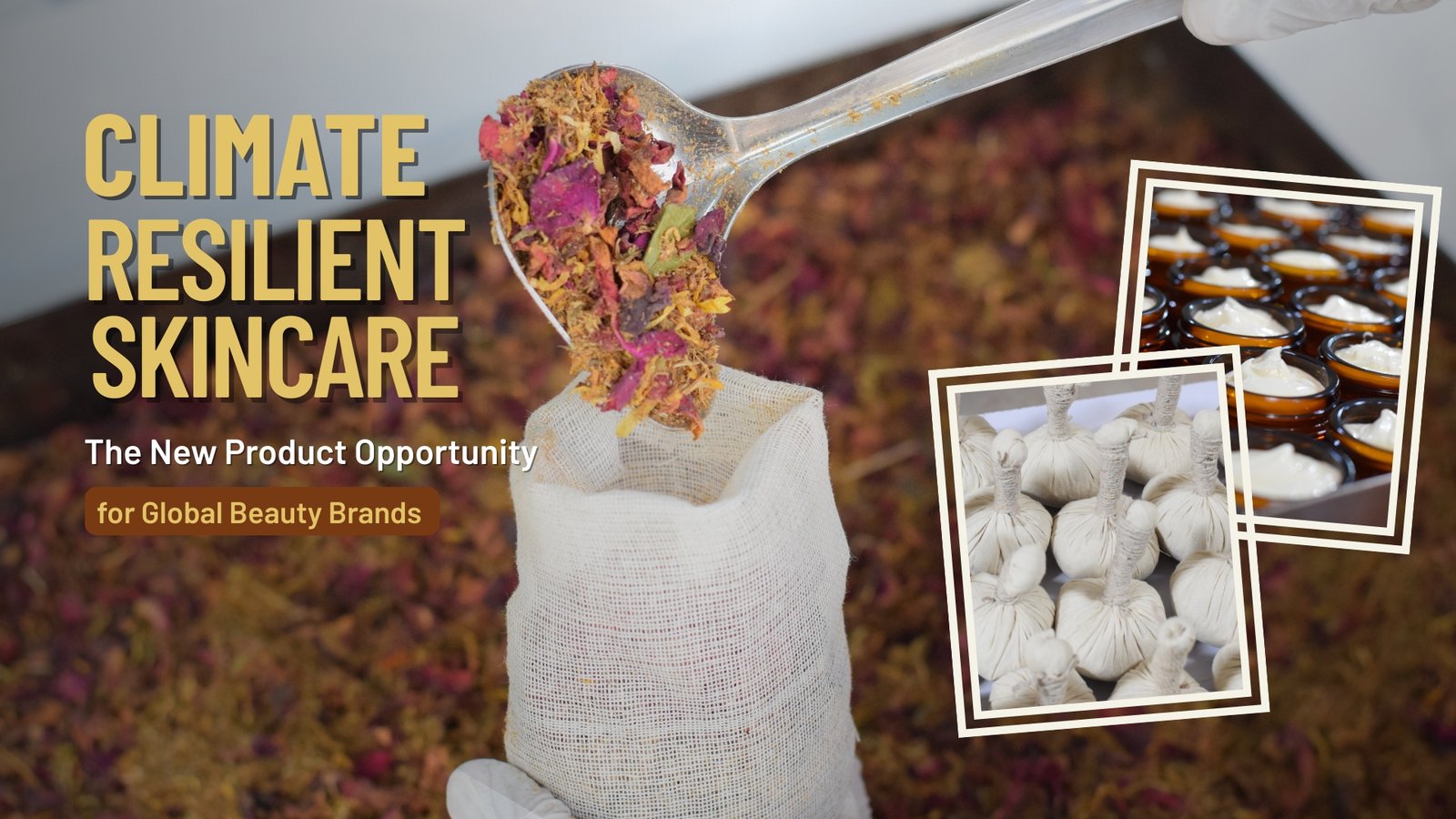
Climate-Resilient Skincare: The New Product Opportunity for Global Beauty Brands
What Is Climate-Resilient Skincare and Why Is It Becoming Important? | How Is Climate Changing Skincare Product Demand? |Which Skin Concerns Are Creating Opportunities for Climate-Resilient Products? |What Are the Best Ingredients for Climate-Resilient Skincare? | How Should Manufacturers Formulate Skincare for Different Climates? | Why Is Stability Testing Especially Important for Climate-Resilient Skincare?| What Climate-Resilient Skincare Products Can Brands Launch?|The process of developing a skincare brand becomes complicated when entrepreneurs start working on product manufacturing. The process requires multiple tasks which include ingredient selection, formula development, packaging choice, product quality assessment, compliance understanding, and stock production determination.Climate is becoming an important part of the skincare conversation. Consumers are dealing with stronger sunlight, heat, humidity, dry air, pollution, sudden temperature changes, and increasingly unpredictable weather patterns. These conditions do not affect every skin type in the same way, but they can change how skin behaves and what consumers expect from their skincare products.
For beauty brands, this creates a new product development opportunity: climate-resilient skincare.
Climate-resilient skincare is not simply about adding another active ingredient to a formula. It is about developing products that are designed around the environmental conditions consumers actually experience. A lightweight gel may be useful in a hot and humid climate, while a richer barrier-supporting product may be more appropriate for cold, dry conditions. Similarly, sweat, increased UV exposure, dehydration, pollution, and indoor air conditioning can all influence product selection.
For manufacturers, this shift means that climate should increasingly be considered during formulation, packaging, testing, product positioning, and market planning.
Climate-resilient skincare can therefore become more than a trend. For global beauty brands, it can provide a practical way to create products for specific environments while building stronger product differentiation.
What Is Climate-Resilient Skincare and Why Is It Becoming Important?
Climate-resilient skincare refers to skincare products developed to help consumers manage skin concerns associated with environmental conditions such as heat, humidity, cold, dryness, UV exposure, pollution, and rapid changes in temperature.
The idea is relatively simple: instead of developing one product for a general skin concern, brands can consider the conditions under which the product will actually be used.
For example, a consumer living in a hot and humid region may experience excess sebum, sweating, clogged pores, and discomfort from heavy creams. A consumer in a cold and dry environment may be more concerned about dryness, tightness, flaking, and maintaining the skin barrier.
This does not mean that climate causes every skin problem. Skin type, age, genetics, lifestyle, cleansing habits, sun exposure, and other factors also matter. However, environmental conditions can influence how the skin feels and how well a formulation performs.
From a product-development perspective, climate resilience can therefore be considered at several levels:
- Formula texture: gel, lotion, cream, balm, oil or solid formats
- Hydration strategy: humectants, emollients and barrier-supporting ingredients
- Oil management: lightweight versus richer lipid systems
- Antioxidant support: formulations designed around oxidative environmental stress
- UV-related positioning: products designed to complement daily sun protection
- Packaging: protection from heat, humidity, oxygen and light where necessary
- Stability: ensuring the product remains suitable under expected storage conditions
This creates an opportunity for brands to move beyond generic claims such as “for all skin types” and develop products with a clearer environmental purpose.
How Is Climate Changing Skincare Product Demand?
Climate-related changes are influencing what consumers look for in skincare, particularly when products are used across different geographic markets.
A product that performs well in one environment may not provide the same consumer experience somewhere else. A rich facial cream, for instance, may feel comfortable during a dry winter but heavy during a hot summer.
This is why climate-adaptive skincare is becoming an interesting product-development direction for international beauty brands.
Hot and Humid Climates
Hot and humid conditions can make heavy formulations feel uncomfortable. Consumers may look for lightweight moisturisers, non-greasy serums, cleansing products, scalp-care products and refreshing formats.
Manufacturers may consider:
- Lightweight emulsions
- Water-based gels
- Fast-absorbing serums
- Lightweight facial oils
- Non-heavy haircare formulas
- Solid cleansing formats
- Products designed for frequent use
The goal is not simply to make a product “light.” The formulation still needs sufficient performance, stability and consumer appeal.
Hot and Dry Climates
Hot and dry environments create a different formulation challenge. Consumers may want hydration without a heavy or sticky finish.
Products can be designed around:
- Hydrating serums
- Barrier-supporting moisturisers
- Lightweight creams
- Lip care
- Body moisturisers
- Scalp hydration products
Cold and Dry Climates
Cold weather and low humidity can create demand for richer moisturising formats.
Potential products include:
- Barrier-supporting creams
- Facial balms
- Body butters
- Facial oils
- Hand creams
- Lip balms
- Intensive scalp and hair treatments
For global brands, this opens the door to seasonal or region-specific product ranges instead of relying on a single formulation for every market.
Which Skin Concerns Are Creating Opportunities for Climate-Resilient Products?
The strongest product opportunities usually come from clear consumer problems.
Instead of beginning with an ingredient, manufacturers and brands can begin with the environmental condition and ask: What does the consumer need from the product in this situation?
| Climate or Environmental Condition | Common Consumer Concern | Potential Product Opportunity |
|---|---|---|
| High heat | Oiliness, sweat, discomfort | Lightweight moisturiser, gel serum |
| High humidity | Heavy skin feel, excess sebum | Lightweight hydration, cleansing products |
| Dry heat | Dehydration, tightness | Hydrating serum, barrier cream |
| Cold weather | Dryness, roughness | Rich cream, balm, body butter |
| Strong sun exposure | Photoaging concerns | Antioxidant skincare + sun protection routine |
| Pollution-heavy environment | Dull appearance, cleansing needs | Antioxidant serum, cleanser |
| Frequent temperature changes | Skin discomfort | Barrier-supporting moisturiser |
| Air-conditioned environments | Dry-feeling skin | Hydrating mist, serum, moisturiser |
The important point for manufacturers is that these opportunities should not be treated as medical claims.
A skincare brand can develop products that support hydration, moisturisation, cleansing, comfort and the appearance of healthy skin without making unsupported disease or treatment claims.
This distinction becomes particularly important when products are prepared for international markets.
What Are the Best Ingredients for Climate-Resilient Skincare?
There is no single “climate-resilient ingredient.” The right ingredient system depends on the environmental condition, product format, skin feel, target market and claims the brand intends to make.
Some ingredient categories, however, are particularly useful when designing climate-focused skincare.
Humectants for Hydration
Humectants help attract and retain water within the skin's outer layers.
Common examples include:
- Glycerin
- Hyaluronic acid
- Sodium PCA
- Betaine
- Aloe-based ingredients
The formulation needs to be designed carefully because simply increasing the concentration of a humectant does not automatically create a better moisturiser.
Emollients and Lipids for Barrier Support
Emollients can help improve the feel and appearance of dry skin by supporting softness and reducing roughness.
Depending on the product concept, manufacturers may work with:
- Plant oils
- Esters
- Shea butter
- Squalane
- Ceramides
- Fatty alcohols
- Other lipid-based materials
The selection depends strongly on the desired texture and climate.
Antioxidant Ingredients
Environmental exposure can increase consumer interest in antioxidant skincare.
Vitamin E, vitamin C derivatives, botanical antioxidants and other scientifically studied antioxidant ingredients may be considered depending on formulation compatibility.
However, brands should avoid turning “antioxidant” into an unlimited marketing claim. Ingredient selection, concentration, stability and supporting evidence all matter.
Botanical Ingredients
Botanical ingredients can provide strong storytelling opportunities for climate-conscious brands, particularly when their sourcing and processing are well documented.
Examples may include green tea, turmeric, aloe vera, calendula, chamomile, rose, hibiscus and other plant-derived ingredients.
For manufacturers, traceability and consistent raw-material quality are as important as the ingredient story itself.
How Should Manufacturers Formulate Skincare for Different Climates?
Formulation for different climates requires more than changing the texture of the product.
A professional manufacturer considers the complete product system.
Start With the Target Climate
The first question should be where and when the product will be used.
A product intended for a tropical market may need a different sensory profile from one intended for a cold and dry market.
The manufacturer should understand:
- Target geography
- Expected temperature range
- Humidity conditions
- Consumer skin concerns
- Product application frequency
- Packaging type
- Expected transportation and storage conditions
Select the Appropriate Texture
Texture strongly influences consumer acceptance.
A hot-climate moisturiser may work better as a gel, gel-cream or lightweight lotion. A winter product may require a richer cream or balm.
Haircare follows a similar principle. A heavy conditioning product may not suit consumers who want lightweight haircare in humid weather, while dry climates may create demand for richer conditioning and scalp-care formats.
Consider the Complete Formula
A climate-focused formula still needs to balance:
- Stability
- Preservation
- pH
- Viscosity
- Sensory performance
- Ingredient compatibility
- Packaging compatibility
- Microbial safety
- Shelf-life expectations
This is where custom formulation skincare can provide an advantage over simply selecting an existing catalogue formula.
Why Is Stability Testing Especially Important for Climate-Resilient Skincare?
A climate-focused product may be designed for consumers living in challenging environmental conditions, but the product itself must also survive its journey through manufacturing, storage, shipping and retail.
This makes stability testing an important part of development.
A manufacturer may need to evaluate how a formulation responds to conditions such as:
- Elevated temperature
- Temperature cycling
- Humidity
- Light exposure
- Long-term storage
- Packaging interaction
The exact testing programme depends on the product and market.
For example, a cream stored in a hot warehouse may behave differently from the same cream kept in a temperature-controlled environment. Changes in viscosity, colour, fragrance, separation or texture can affect the consumer experience.
Packaging also becomes part of the equation.
A formulation may be stable in laboratory conditions but experience problems when placed into an unsuitable package.
This is why packaging compatibility testing should be considered alongside formulation stability.
For global beauty brands, manufacturers should ideally assess not only whether the product is stable on a laboratory shelf, but also whether the finished product is practical for its intended distribution route.
What Climate-Resilient Skincare Products Can Brands Launch?
Climate resilience can be applied across both skincare and haircare.
Instead of creating a single “climate skincare” product, brands can build a complete product family around specific environmental needs..
Facial Skincare
Potential product categories include:
- Lightweight moisturisers
- Gel creams
- Hydrating serums
- Barrier-supporting creams
- Facial oils
- Cleansers
- Facial mists
- Balms
- Overnight treatments
- Lip care
Body Care
Climate-focused body care can include:
- Body lotions
- Body butters
- Hand creams
- Foot creams
- Body oils
- After-sun body products
- Cleansing bars
Haircare
Environmental conditions also influence haircare needs.
Potential categories include:
- Lightweight conditioners
- Shampoo bars
- Scalp serums
- Hair oils
- Leave-in treatments
- Anti-frizz products
- Hair masks
- Scalp moisturising products
A brand can also create seasonal collections—for example, a summer hydration range and a winter barrier-care range.
This creates opportunities for climate-resilient beauty products without requiring the brand to completely change its identity.
Can Climate-Resilient Skincare Become a Sustainable Product Opportunity?
Climate resilience and sustainability can complement each other, but they should not automatically be treated as the same concept.
A climate-focused product may be designed for a specific environment while still creating sustainability challenges elsewhere in the product lifecycle.
For example, concentrated or solid products can potentially reduce the amount of water transported through the supply chain. Smaller or lighter formats may also reduce transportation weight.
Waterless formats can include:
- Balms
- Solid cleansers
- Shampoo bars
- Body bars
- Anhydrous facial oils
- Solid treatment formats
However, sustainability requires a broader assessment.
Manufacturers and brands should also consider:
- Packaging material
- Packaging weight
- Recyclability
- Product concentration
- Manufacturing energy
- Ingredient sourcing
- Transportation
- Product waste
- Consumer usage patterns
This is why sustainable skincare manufacturing should focus on the complete product lifecycle rather than one marketing claim.
A lightweight package that cannot be recycled may not necessarily be a better environmental choice than a slightly heavier package with a well-established recycling route.
The right approach is to evaluate the entire system.
How Can Global Beauty Brands Build a Climate-Resilient Product Range?
A global brand does not necessarily need a different product for every country.
A more practical strategy is to identify climate groups and develop products around them.
For example:
| Climate Group | Product Direction | Example Formats |
|---|---|---|
| Tropical | Lightweight hydration and cleansing | Gel, serum, lightweight lotion |
| Hot and dry | Hydration + moisturisation | Serum, cream, facial oil |
| Cold and dry | Barrier and intensive moisturisation | Cream, balm, body butter |
| Temperate | Balanced everyday care | Lotion, cream, serum |
| High-pollution cities | Cleansing + antioxidant positioning | Cleanser, serum, mask |
This approach allows a brand to organise its product portfolio around consumer needs rather than geography alone.
A manufacturer can then work with the brand to determine whether one base formula can serve multiple markets or whether regional adjustments are necessary.
This can be particularly useful for brands planning international expansion.
What Should Brands Ask a Manufacturer Before Developing Climate-Resilient Products?
Before selecting a manufacturer, brands should ask questions that go beyond MOQ and price.
A useful manufacturer evaluation should include:
Formulation Capability
Ask:
- Does the manufacturer offer custom formulation?
- Can they modify texture and sensory characteristics?
- Can they work with botanical or active ingredients?
- Do they have formulation and R&D capabilities?
- Can they develop different formats for different climates?
Testing Capability
Ask whether the manufacturer can support:
- Stability testing
- Microbial testing
- Compatibility testing
- pH testing
- Viscosity testing
- Appearance and odour evaluation
- Other relevant analytical testing
A low manufacturing price does not compensate for unclear ownership of a formula or poorly defined commercial terms.
Documentation and Agreements
Before commercial production, brands should understand:
- Formula ownership
- Intellectual property rights
- Confidentiality
- NDA terms
- Formulation agreements
- Exclusivity conditions
- Change-control procedures
- Batch documentation
A low manufacturing price does not compensate for unclear ownership of a formula or poorly defined commercial terms.
What Are the Main Manufacturing Challenges With Climate-Resilient Skincare?
Climate-resilient skincare sounds straightforward, but formulation can become complicated when several requirements overlap.
A product may need to be lightweight while still providing sufficient moisturisation. It may need to remain stable under higher temperatures while maintaining the same texture. A natural or botanical formula may need additional stability work. Packaging may also need to protect the formulation from heat, light, oxygen or moisture.
Preservation is another important consideration.
A water-based skincare product usually requires an appropriate preservation strategy because water can support microbial growth. Anhydrous products have different preservation considerations, but “waterless” does not automatically mean “microbe-proof.”
Moisture can enter a product through:
- Wet hands
- Bathroom humidity
- Poor storage
- Consumer contamination
- Packaging design
Therefore, anhydrous skincare formulas still require appropriate safety and stability evaluation.
This is an important distinction for brands that want to market waterless or low-water products.
How Much Does It Cost to Develop Climate-Resilient Skincare?
There is no universal cost because the final investment depends on formulation complexity, MOQ, ingredients, packaging, testing and the number of products being launched.
A useful budget should be divided into several components.
| Cost Area | What It Can Include |
|---|---|
| Product development | Formula development, laboratory work, samples |
| Ingredients | Base materials, botanical extracts, actives |
| Testing | Stability, microbial and other relevant testing |
| Packaging | Containers, pumps, tubes, jars, labels |
| Manufacturing | Filling, processing and batch production |
| Compliance | Documentation, regulatory review and required registrations |
| Branding | Labels, artwork, cartons and marketing materials |
| Logistics | Freight, storage and distribution |
For a startup, the biggest mistake is often focusing only on the manufacturing price per unit.
A better calculation is:
Total product cost = formulation + ingredients + packaging + testing + manufacturing + compliance + logistics + branding
This gives founders a more realistic picture of the investment required.
For a new brand, starting with a focused range of two to four products can also make product testing, inventory management and customer feedback easier.
Is Climate-Resilient Skincare a Better Opportunity Than Conventional Skincare?
Climate resilience is not necessarily a replacement for conventional skincare. It is a product-development lens that can make conventional categories more relevant.
A basic moisturiser can become a hot-climate lightweight moisturiser.
A facial oil can become a dry-climate nourishment product.
A cleanser can be developed around the needs of consumers who cleanse more frequently because of heat and sweating.
A scalp serum can be positioned around environmental dryness or comfort.
This means brands do not always need to invent completely new product categories.
They can rethink existing categories around specific environmental conditions.
That can be commercially useful because consumers already understand products such as moisturisers, cleansers, serums, oils and hair treatments.
The differentiation comes from why the product was formulated, how it performs, and how clearly the brand communicates that purpose.
What Is the Future of Climate-Resilient Skincare?
The next stage of climate-focused beauty is likely to become more specific.
Instead of simply talking about “natural skincare” or “clean beauty,” brands can increasingly build products around the conditions in which consumers live.
Future product development may combine:
- Climate data
- Consumer skin behaviour
- Seasonal demand
- Ingredient science
- Advanced formulation
- Packaging technology
- Stability testing
- Personalised skincare recommendations
This could lead to product ranges designed specifically for hot and humid summers, cold winters, dry climates, urban pollution or frequent environmental changes.
For manufacturers, the opportunity is to become more involved in the product strategy rather than only producing the finished item.
A strong manufacturing partner can help a brand move from:
Climate problem → consumer need → formulation concept → prototype → testing → packaging → commercial production
That development pathway can make climate resilience a genuine product strategy rather than another short-term marketing phrase.
Final Takeaway, Why Climate Resilience Is a New Product Opportunity
Climate is changing the way consumers experience skincare.
Heat, humidity, dry air, cold weather, pollution, strong sunlight and temperature fluctuations can all influence what consumers want from a skincare or haircare product.
For global beauty brands, this creates an opportunity to develop products around real environmental needs rather than relying only on broad product categories.
The opportunity is especially relevant for manufacturers because climate-focused product development requires more than an attractive ingredient list. It requires decisions about formulation, texture, stability, packaging, testing, sourcing and market positioning.
The strongest approach is to begin with the consumer's environment, identify the problem, develop a suitable product concept and then validate the formulation through proper testing.
For brands planning international expansion, this approach can also make product portfolios more relevant across different markets.
Climate-resilient skincare is therefore not simply another skincare trend. It represents a shift toward more environment-aware product development—and for beauty manufacturers and global brands, that shift can create an entirely new space for innovation.
A Practical Climate-Resilient Product Development Checklist
Before taking a climate-focused product to production, brands should ask:
- What climate is the product designed for?
- What consumer problem is it solving?
- Is the texture appropriate for that environment?
- Are the selected ingredients suitable for the intended formula?
- Has the formula undergone appropriate stability testing?
- Is the packaging compatible with the formulation?
- How will the product perform during transportation and storage?
- Are the product claims supported by appropriate evidence?
- Are regulatory requirements for each target market understood?
- Can the manufacturer scale the product after the initial launch?
A clear answer to these questions can turn a climate-focused idea into a commercially practical skincare product.
FAQs:
1. What is climate-resilient skincare?
Climate-resilient skincare refers to products developed with specific environmental conditions in mind, such as heat, humidity, dryness, cold, pollution and increased environmental exposure. The goal is to create formulas that provide an appropriate texture, hydration level, sensory experience and performance for the intended conditions.
2. Is climate-resilient skincare suitable for all skin types?
Not automatically. Climate and skin type are different considerations. A person with oily skin may prefer lightweight products in humid weather, while someone with dry skin may need richer moisturisation. Formulas should therefore be developed around both environmental conditions and intended consumer needs.
3. What ingredients are commonly used in climate-focused skincare?
Ingredients may include humectants such as glycerin and hyaluronic acid, emollients and plant oils, barrier-supporting ingredients, antioxidants and selected botanical ingredients. The right combination depends on the product concept and target climate.
4. Does climate-resilient skincare require custom formulation?
Not always. A brand can start with an existing suitable formula if it meets its product requirements. However, custom formulation skincare can provide greater control over texture, ingredient selection, sensory performance, packaging compatibility and climate-specific positioning.
5. Can climate-resilient skincare include waterless products?
Yes. Balms, facial oils, solid cleansers, shampoo bars and other anhydrous formats can be developed as climate-conscious product options. However, waterless does not automatically mean preservative-free or maintenance-free. Moisture exposure, packaging and microbial safety still need to be considered./p>
6. Does hot weather affect skincare stability?
It can. Elevated temperatures can influence viscosity, colour, fragrance, emulsion stability and ingredient performance. Appropriate stability testing helps manufacturers understand how the finished product behaves under expected storage and transportation conditions.
7. Can the same skincare formula be sold globally?
Sometimes, but not always. A formulation may work across multiple markets, while other products may need adjustments based on climate, consumer expectations, packaging, regulatory requirements or transportation conditions. A manufacturer should evaluate the intended markets before finalising the formulation.
8. Is climate-resilient skincare the same as sustainable skincare?
No. Climate resilience focuses on product performance and consumer needs under environmental conditions. Sustainability considers the broader environmental impact of ingredients, packaging, manufacturing, transportation and product use. The two concepts can support each other but should not be treated as identical.
9. What should a brand check when choosing a climate-focused skincare manufacturer?
Brands should evaluate formulation expertise, R&D capability, testing support, raw-material quality, packaging compatibility, documentation, manufacturing standards, MOQ, scalability and experience with the target market. A manufacturer should be able to explain how the product will be developed and tested rather than simply offering a catalogue formula.